Store revenue, executive questions and forecasting on one set of definitions
Retail
A retailer with Microsoft Fabric in production wanted forecasting, Copilot questions and anomaly detection on its data. We made the definitions consistent first, then built the AI work on them and kept them that way.
The retailer’s Fabric platform was in daily use, with semantic models behind its reporting and store revenue already streaming in. Some definitions in those models had drifted from what the business had agreed, and an assistant or a forecast reading them would have inherited the drift. So the definitions were reviewed and realigned before any AI was prepared, and a fixed review rhythm keeps them aligned.
AI use cases, each on data already in the platform
3
stages: three in sequence, stewardship alongside
4
review cadences: monthly and quarterly
2
months of engagement
9
No outcome figures are published for this engagement: nothing exists that would let you check them, so what was built is described in full instead. Anonymised by sector and size, because the confidentiality that protects this client would protect you too. Sector and outcomes are real; identifying detail is not.
Before and after
Drifting
Semantic models in daily useSome definitions drifted from what was agreed
KPIs not checked with their ownersNo schedule for catching drift
AI ideas without a governed baseEach would have needed its own data
Realigned
Definitions realignedReports and AI read the same figures
Monthly and quarterly reviewsDrift caught on a schedule
3 AI use cases on the semantic layerForecasting, Copilot questions, anomaly detection
From a semantic layer drifting without review to one that is realigned, reviewed on a schedule and read by the AI work.
The engagement in full
Client
A retailer of 500 to 1,000 people, with Microsoft Fabric in production, semantic models over Direct Lake and a store-revenue stream.
Situation
Some definitions in those models had drifted from what the business had agreed, and nobody was checking. An assistant or a forecast reading them would have inherited the drift, and an assistant that answers inconsistently is harder to correct than a report that does.
Mandate
Review the semantic layer and make its definitions consistent, prepare AI use cases on it rather than beside it, and steward the platform’s architecture.
What we built
FoundationA review of the semantic models and the KPIs together, with findings ranked by priority and 3 AI use cases identified.
ActivationThe drifted definitions realigned, and the executive model prepared so Copilot answers in the same terms the executives use.
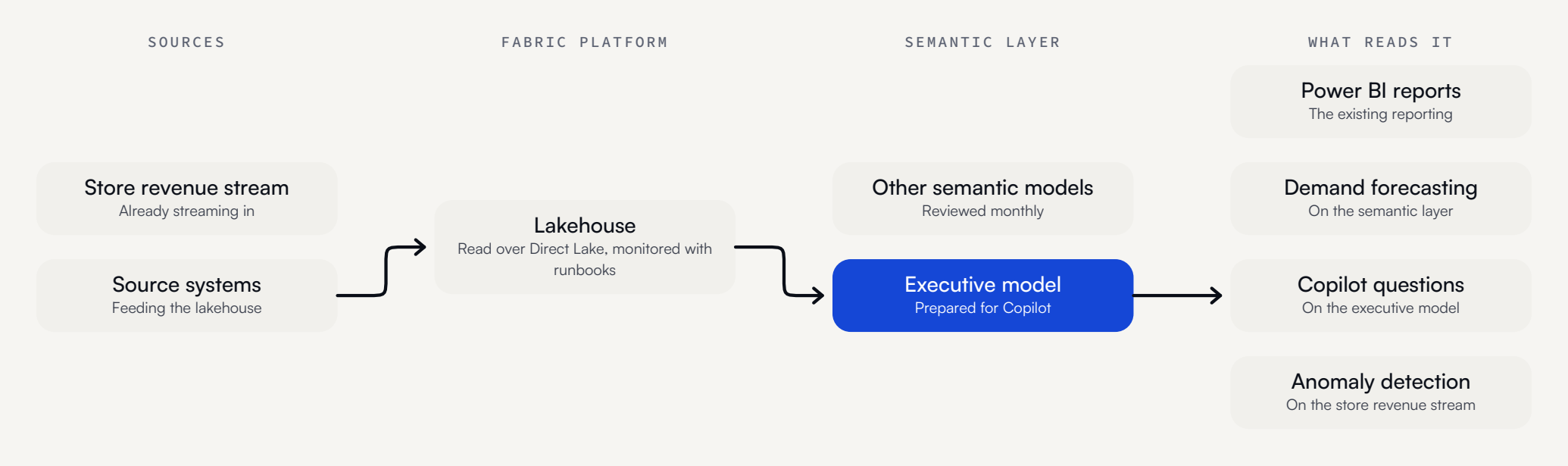
AccelerationDemand forecasting, Copilot questions and anomaly detection prepared as extensions of the semantic layer rather than beside it, each on data the business already trusts.
StewardshipA monthly semantic model review and a quarterly KPI review with the business, with runbooks and monitoring throughout.
Foundation: the review
The review looked at the models and the KPIs together, because a drifted definition shows up as a KPI its owner no longer recognises. Semantic models in production were read measure by measure, KPIs were checked with their business owners against how the business steers, and the findings were written up and ranked by priority: where definitions had drifted, and 3 AI use cases worth preparing.
Activation: the executive model for Copilot
With the definitions realigned, the executive model was prepared so Copilot answers in the same terms the executives use: each measure described in plain terms through annotations, the words executives use mapped to the model as dimension synonyms, and simple row-level security for that audience.
The 4 stages
AI was only prepared once the definitions it reads had been realigned in the Activation Sprint.
FoundationReview and findings
Activation SprintDefinitions realigned
AccelerationAI use cases prepared
StewardshipReviews on a schedule
Stewardship: the review rhythm
The rhythm set: a model review monthly, a KPI review quarterly, runbooks and monitoring throughout.
Semantic model reviewMonthly
KPI reviewQuarterly, with the business
Runbooks and monitoringOngoing
The architecture
The reports and the 3 AI use cases read the same reviewed semantic layer. Nothing was added beside it with data of its own.
Architecture decisions
Decision
Rejected alternative
Why
Realign definitions before any AI
Starting the AI work straight away
An assistant reading drifted definitions answers inconsistently and is harder to correct than a report.
AI as extensions of the semantic layer
AI use cases as separate projects
Forecasting and Copilot read governed data that already exists, with no data of their own.
Anomaly detection on the store-revenue stream
A new feed built for AI
The stream was already in place, so the detection reads data the business already trusts.
Copilot on the executive model first
Copilot on every model at once
One prepared model gives reliable answers before the scope widens.
What the client has today
A written review of its semantic models and KPIs, with findings ranked by priority.
Drifted definitions realigned, so reports and AI read the same figures.
An executive model prepared for Copilot questions.
Demand forecasting and anomaly detection on the store-revenue stream, prepared on governed data.
Monthly model reviews, quarterly KPI reviews, runbooks and monitoring.
Where it left them
Copilot, the forecast and the store-revenue checks read the same definitions as the reports, and the monthly review keeps them aligned.